
Explore by application.
Every industry below comes with its own tolerances, certifications, and failure modes. Select yours to see the specific geometries and material grades we build for it.
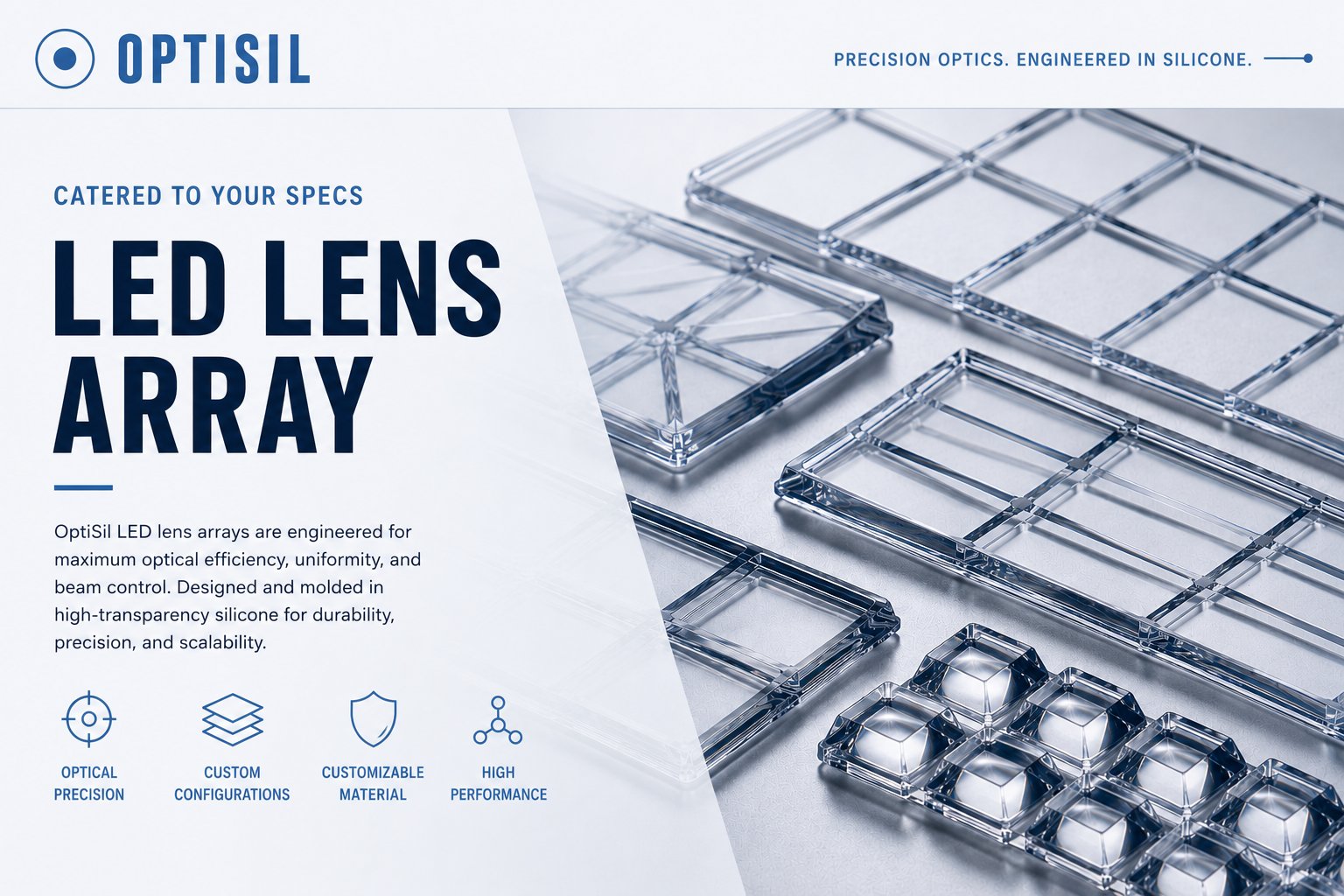
Multi-lens and reflector modules for LED arrays
We mould and machine multi-lens and reflector modules that shape, direct, and distribute light from multiple LED packages within a single fixture — collimating, diffusing, or splitting output across zones as the beam pattern requires. Each cavity holds the same ±20 µm tolerance as our single-element optics, keeping beam angle and intensity consistent LED to LED and unit to unit, at volume.
- Multi-cavity arrays matched to LED pitch and package size
- Integrated reflector-plus-lens assemblies for collimation and spread
- Total internal reflection (TIR) and refractive optics in a single cavity
- High-temperature, UV-stable silicone formulations for close LED-junction mounting
- Automotive, architectural, signage, and horticultural lighting programs
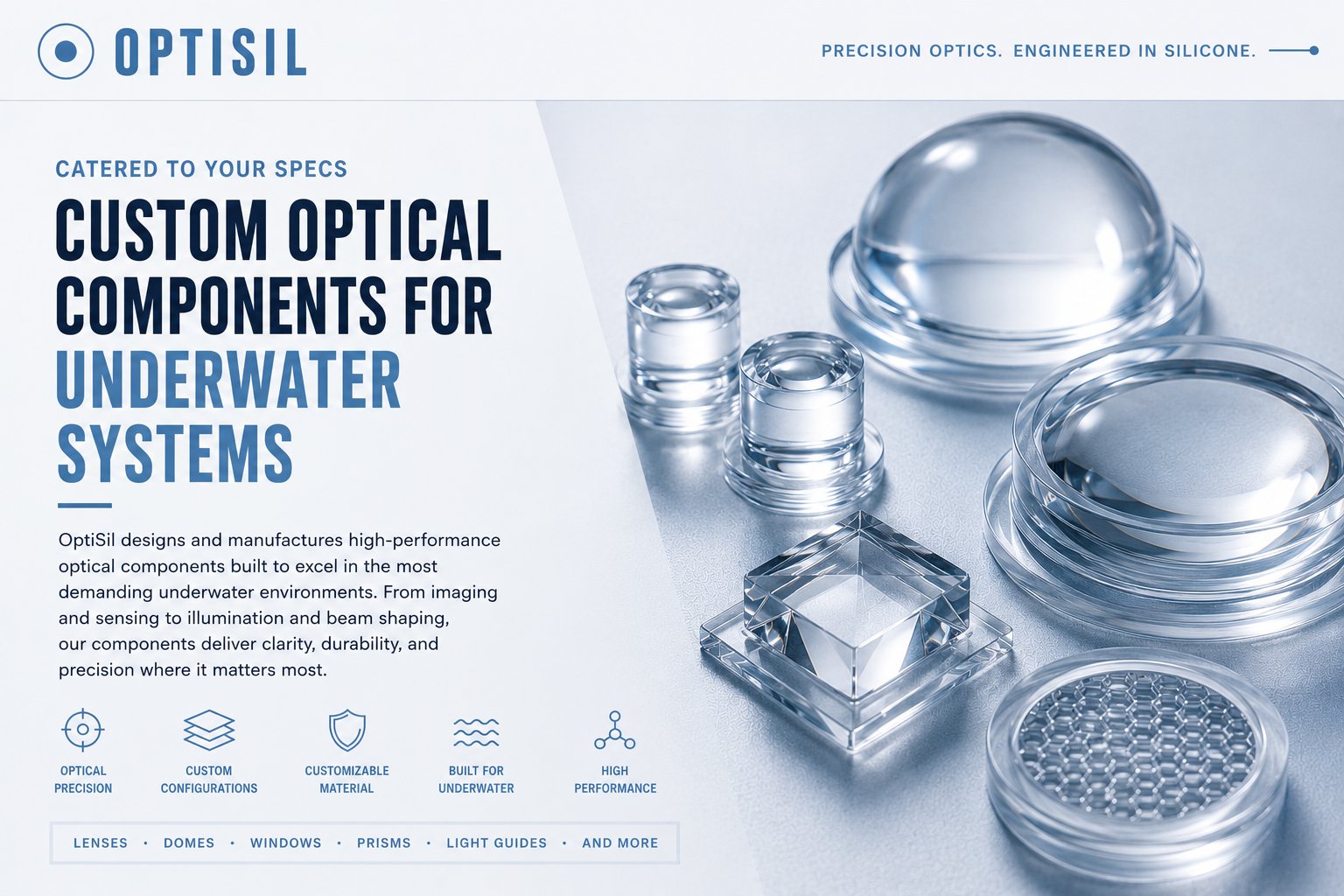
Underwater optical systems
Silicone's natural flexibility allows dome lenses to equalise pressure at depth without cracking or crazing — a fundamental failure mode of glass and acrylic equivalents. Our subsea domes maintain optical integrity to 600m.
- ROV and AUV camera domes rated to 600m
- Navigation buoy lens housings — 10yr UV stable
- Sonar transducer acoustic windows
- Tidal turbine sensor enclosures
- Oceanographic research instrument optics
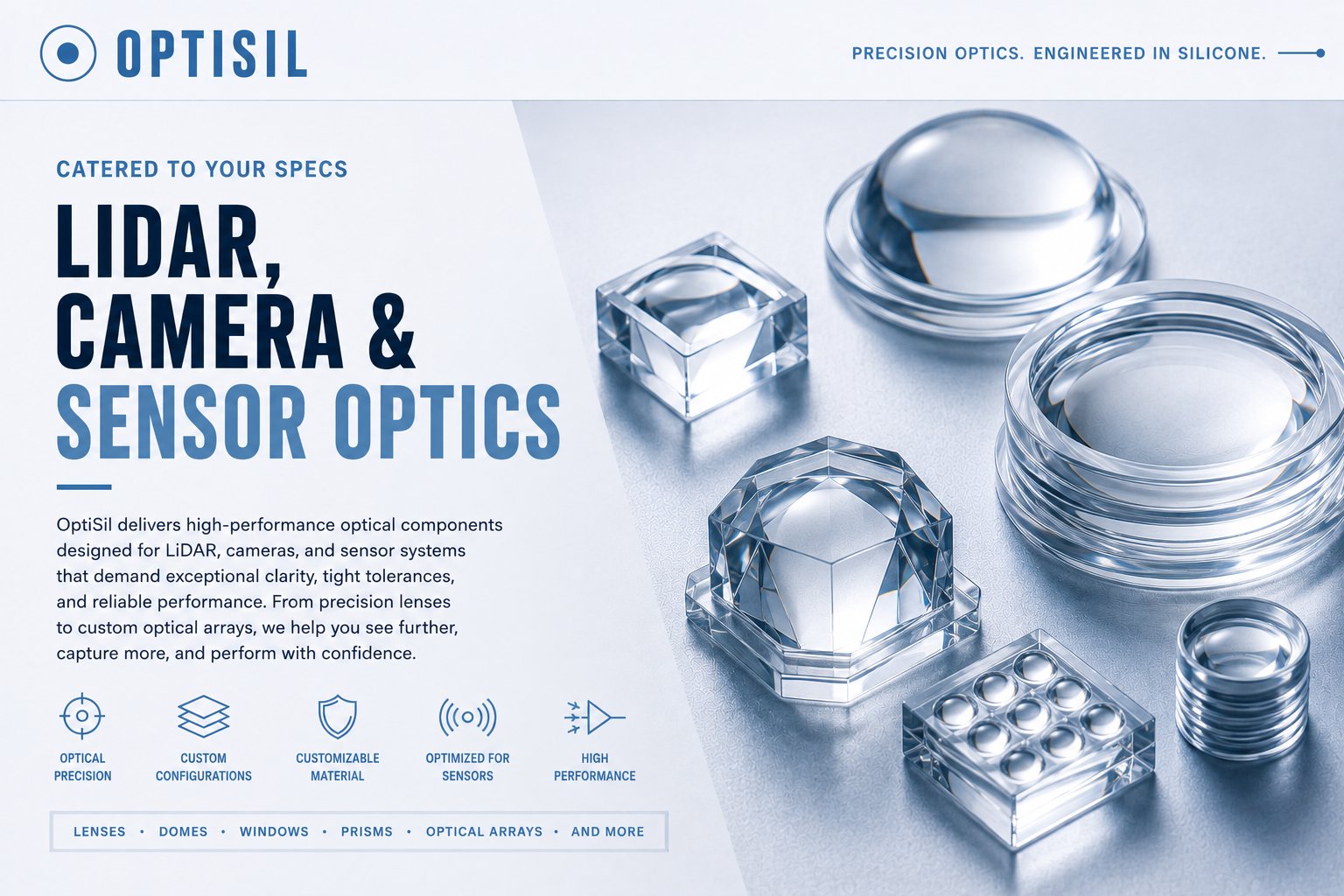
LiDAR, camera & sensor optics
Autonomous and airborne platforms demand optics that perform consistently across extreme temperatures, vibration, weather, and weight constraints. Silicone's thermal stability from −40°C to +125°C meets automotive qualification standards where acrylic fails, and its low density (~1.1 g/cm³) delivers full optical performance at a fraction of the mass glass requires.
- LiDAR dome covers — 905nm and 1550nm optimised
- Camera and gimbal protective enclosures, ground to airborne
- Ultrasonic sensor windows and radar radome materials
- Satellite window seals and high-altitude balloon instrument optics
- AEC-Q200 and UV-stable stratospheric-qualified formulations

Laboratory and instrument optics
Research environments demand materials with precisely known and stable optical properties. OptiSil supplies documented-refractive-index silicone optics with full traceability for integration into published scientific instrumentation.
- Spectroscopy cell windows and lenses
- Fluorescence and confocal microscopy optics
- Vacuum chamber viewports and feedthroughs
- Interferometer and beam-splitter assemblies
- Flow cytometry and diagnostic instrument windows
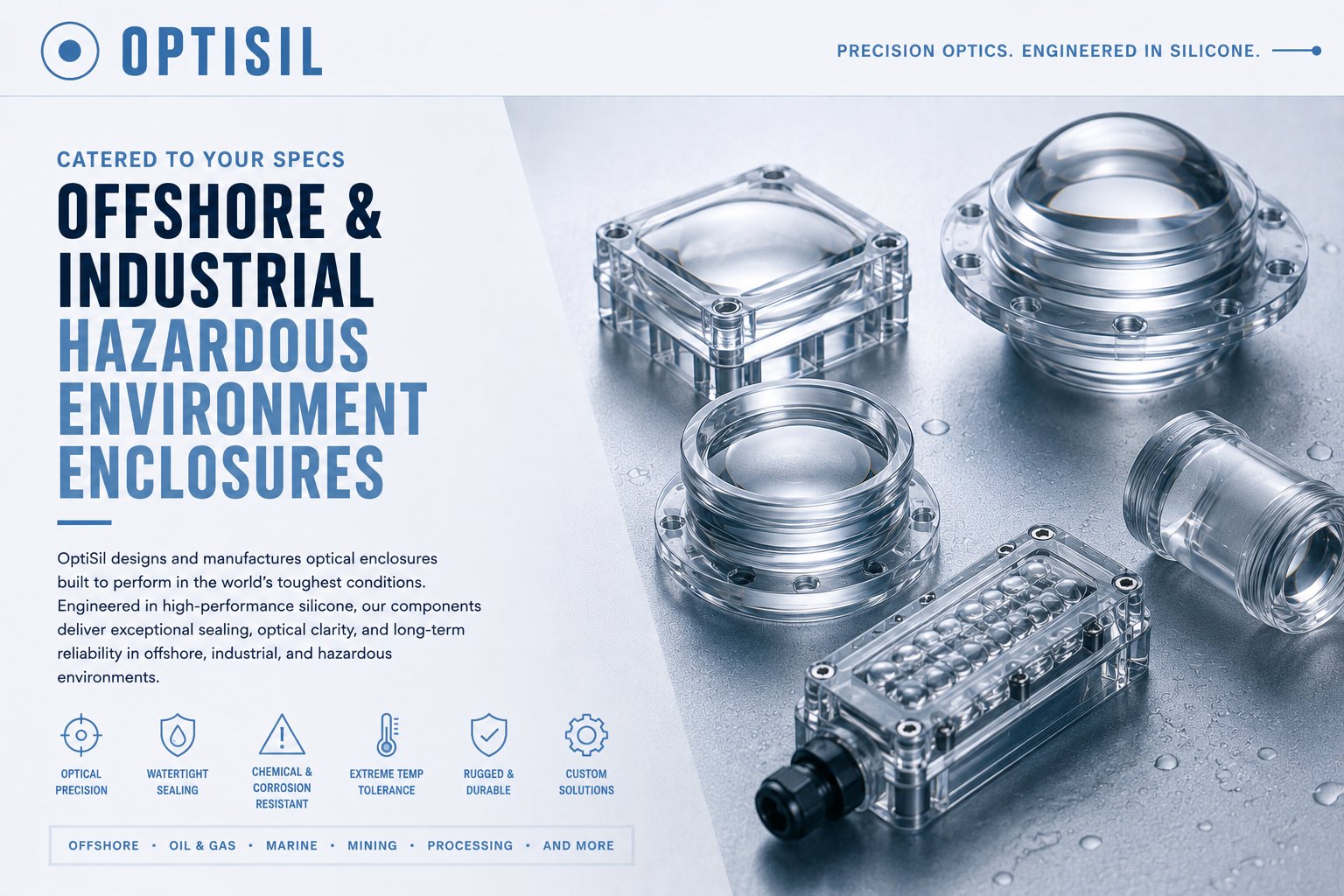
Hazardous environment enclosures
Silicone optics resist hydrocarbon solvents, salt fog, and wide thermal cycling — making them the material of choice for CCTV domes on oil platforms and process monitoring cameras in chemical plants.
- High-pressure vessel sight glasses
- Wind turbine nacelle camera lenses
- Process monitoring optical windows
- Pipeline inspection camera domes
- ATEX-compatible formulations available
Speak to an engineer.
Our optical engineers will review your operating environment and recommend the right silicone formulation and geometry for your application.
Request a Custom QuoteMaterial &
optical specifications
Full technical data for OptiSil optical silicone formulations. All values represent typical performance at 23°C unless otherwise stated.

Optical Properties
| Refractive Index (589nm) | 1.41 – 1.55 (formulation dependent) |
| Abbe Number (Vd) | 42 – 55 |
| Transmission (400–800nm) | ≥ 98% |
| Transmission (350nm) | ≥ 90% (UV-grade) |
| Transmission (1000–1700nm) | ≥ 96% (NIR-grade) |
| Haze (ASTM D1003) | < 0.5% |
| Birefringence | Optically isotropic |
| Surface Roughness (Ra) | < 2nm (polished mould) |
Mechanical Properties
| Shore Hardness | 10A – 80A (custom) |
| Tensile Strength | 3.5 – 9.0 MPa |
| Elongation at Break | 200% – 600% |
| Tear Strength | 15 – 45 kN/m |
| Compression Set | < 15% (72h / 175°C) |
| Density | 1.05 – 1.25 g/cm³ |
Thermal Properties
| Operating Temperature | -60 to 220°C |
| Autoclave Resistance | 134°C / 3 bar stable |
| Thermal Conductivity | 0.2 – 0.3 W/(m·K) |
| CTE | ~300 ppm/°C |
| Flammability | UL94 V-0 |
Environmental & Chemical
| UV Stability | Stable >10 years outdoor exposure |
| Saltwater Resistance | No degradation (tested 5yr) |
| Ozone Resistance | Excellent |
| Hydrocarbon Oils | Minimal swell <3% |
| IP Rating | IP68 achievable (by design) |
| Depth Rating | To 600m (SSD series) |
Compliance
| Food Contact | FDA 21 CFR 177.2600 |
| Biocompatibility | ISO 10993 (medical grades) |
| RoHS | Compliant |
| REACH | Compliant — SVHC free |
| Automotive | AEC-Q200 qualification available |
| Military | MIL-A-46146 ref. formulations |
Request full datasheets
Full material datasheets, TDS, SDS, and optical characterisation reports are available on request. NDA-covered data available for qualified projects.